Taiwan Keynote
DEEP ECOLOGY AND THE CONSERVATION OF NATURE – Keynote address by John Seed to APNEC-10 (Asia-Pacific NGO Environmental Conference) Taipei, Nov 21 2011In spite of the modern delusion of alienation, of separation from the living Earth, we are NOT aliens, we belong here. The human being is Earth-born, the result of 4000 million years of continuous evolution, and the complex, exquisite biology from which we emerged inevitably remains the matrix, the grounding of any sane humanity.
We have all heard the alarming news: For example, Dr. Raymond Dassman, Professor of Biology, University of California announced that “The 3rd World War has begun: it is being waged against the Earth.”
, More recently, at the end of 2009, , Professor Kevin Anderson, director of the Tyndall Centre for Climate Change and one of the UK’s most senior climate scientists, stated that only around 10 per cent of the planet’s population – around half a billion people – will survive if global temperatures rise by 4C.
Two years earlier, the UN Intergovernmental Panel on Climate Change (IPCC) told the world that at current rates of increase of fossil fuel emissions, we were heading toward a rise in global average temperatures of around 6C by the end of this century, leading to mass extinctions on a virtually uninhabitable planet. The Proceedings for the National Academy of Sciences (NAOS) has reported that current fossil fuel emissions are exceeding this worst-case scenario and, in August 2010 NAOS stated that the science of climate change is in the category of those theories that had “been so thoroughly examined and tested, and supported by so many independent observations and results, that their likelihood of subsequently being found to be wrong is vanishingly small. Such conclusions and theories are then regarded as settled facts.”
We have all heard the news. Yet it has not changed our behaviour except in rather trivial ways.
So how will we change our thinking and our behavior? What is needed? Not more horrifying statistics surely. Everybody already knows. We feel helpless and disempowered. Scientists warn that we are the last generation of humanity that may have the chance to avert biological collapse and the destruction of the systems that support complex life on Earth. Professor Paul Ehrlich warns us “ that we’re sawing off the branch that we’re sitting on”. To me this indicates some kind of psychological problem no matter how much money we can get by selling the timber in that branch.
I graduated in Psychology at Sydney University in the mid-’60’s. After a stint as an IBM systems engineer in London, in 1979, by chance, I found myself embroiled in what turned out to be the first direct action in defense of the rainforests to take place in Australia or indeed, anywhere in the world. For the next 5 minutes of my talk, I will project behind me part of a film titled “Earth First” that I made about the protection of Australia’s rainforests. This film can be viewed online and after the film I will project the address of the website where you can find the script of this talk with hyperlinks to this film and to many other documents and videos that expand on this talk for those who are interested.
Terania Creek was this site of this action and it happened to be adjacent to the community where I had been living for five years. I somehow found myself involved in the defense of the rainforest there and suddenly everything changed. I heard the trees screaming. I heard them calling to us for help and I couldn’t resist that call. If I went to see a psychiatrist and said that I heard the Earth screaming, wouldn’t my experience be reduced to a purely personal pathology? It would show that there was something wrong with me. Perhaps he would want me to talk about my childhood?
At first my experience was frightening and bewildering. The trees screaming? How could this be? In later years as I studied the matter , I discovered that this rainforest that I had found myself defending was part of the original flora of Australia. 130 million years ago when Australia was part of the mighty super continent Gondwanaland, joined to South America and Antarctica, before the continents drifted apart, all of it was covered in rainforest. Indeed, my ancestors were evolving within this very rainforest for nearly all those 130 million years, and it is only during the last few million years that we sought our fortunes down on the ground. So it became less surprising to see how some kind of psychological or spiritual contact with the rainforest was possible, and it became rather more surprising that more people didn’t seem to be experiencing it in this way.
After Terania Creek I went on to start the Rainforest Information Centre, the first NGO in the world to have the rainforests as its agenda with forest protection projects from India to Ecuador, from New Guinea to Siberia.
However, it soon became apparent that the Earth could not be saved one forest at a time.
In spite of our successful direct actions defending the sub-tropical rainforests of New South Wales in 1981, the temperate rainforests in Tasmania in 1982 and the tropical rainforests of far north Queensland in 1986, it was clear that for every forest protected during those years, thousands disappeared around the world.
And of course the planet could not be saved one issue at a time. While we were protecting forests, a mass extinction of life was underway – 100 species a day lost from the planet – and humanity threatening to choke on our own exhaust gasses and the other “byproducts” of our progress.
By the early ’80’s it was obvious to me that unless we could somehow address the underlying psychological or spiritual disease that afflicts modern humanity and allows us to imagine that we can somehow profit from the destruction of our own life support systems. Unless we could deal with this madness, all of our actions and projects were merely symbolic. You can’t just save a forest. Its either going to be a green planet or a bowl of dust.
It was at this point that I discovered deep ecology and for the first time, found an analysis of our situation that helped me understand how we had come to our awful plight and perhaps what we can do about it.
Deep Ecology is the name of a philosophy of nature that has been exerting a profound effect on environmentalism in recent decades.
Over thousands of years, modern humans have developed an anthropocentric or human-centred perspective. Where I come from this anthropocentrism stems from the Judeo-Christian tradition. The modern psyche and all the institutions it has created are based on the idea that the world was created only for the benefit of human beings. Only humans were created in God’s image, only humans have a soul, only humans have intrinsic value. The only value that other species, rivers, forests, oceans and mountains can have, is instrumental value as a resource for humans. The Christian bible claims that it is humanity’s role to “subdue and dominate” all the other creatures and that they are to be “in fear and trembling” of us.
Within this paradigm, the world is a just stage and we humans are the star of the drama, everyone else is just “bit players”, scenery.
Now the science of ecology (as well as the wisdom of indigenous peoples) denies this perspective: the world is not a pyramid with humans on top, but a web. And we humans are not the spider in the middle, we are just one strand in that web and as we destroy the other strands, we destroy ourselves.
After thousands of years of conditioning, we have inherited shallow, fictitious selves, disconnected from nature.
James Lovelock, the scientist who proposed the Gaia hypothesis (which says that the Earth is not just a lump of rock with “resources” growing on it but is a living integrated being), has said that what we are doing to the world is as if the brain were to decide that it was the most important organ in the body and started mining the liver.
Even though in recent decades our IDEAS may have changed to incorporate the insights of ecology, ideas are not just in our heads, they’re embodied in the way that the world is arranged. All of the institutions of our society and the very language we speak, conspire to bind us in this outmoded and now (wedded to our powerful technologies and growing populations) deadly way of perceiving our world. Our ideas may change yet our institutions and personalities were forged in this mold and we seem incapable of giving substance to our new, ecological, vision.
Arne Naess, Emeritus Professor of Philosophy at Oslo University, the man who coined the term “Deep Ecology” wrote “it is not enough to have ecological ideas, we have to have ecological identity, ecological self”.
He pointed out that a sense of responsibility or duty is a “treacherous basis” for conservation. How many of us are capable of altruism? As long as we are in the grip of the illusion that the Earth is other than our very self it seems unrealistic to suppose that we can make the very difficult sacrifices in our lives and societies that would be needed to live contentedly within the constraints of the ecological systems.
If we can identify with the Earth we don’t need altruism. If we have the experience of ourselves not as isolated, separate, skin encapsulated egos but as part of the larger body of the Earth, then the defense of nature becomes merely self-defense and this does not require a highly elevated moral stature. Self-interest comes “naturally” and it seems more hopeful to expand the sense of self to include the air (my breath) and water (my blood) and soil (my body), than to suddenly imagine most of us becoming “selfless”, acting against our perceived self-interest to protect these things.
Still, through thousands of years of conditioning absorbed by osmosis since the day we were born, we have succeeded in creating this incredibly pervasive illusion of separation from nature.
Now the fact that this is entirely an illusion can be demonstrated very simply by holding your breath for about 5 minutes. That is, I am not talking about anything particularly mystical, it is very straight forward. We can name it “the atmosphere” and we can say “oh what a good person that is sacrificing their self interest by working to protect the atmosphere instead of making lots of money” as though the atmosphere was “out there”. But it is not “out there”. None of it is “out there”. It is all constantly migrating and cycling through us, whether it’s the atmosphere, the water, or the soil. There is no “out there”, it is all “in here”, but most modern people don’t feel that.
As long as “the” environment is experienced as “out there”, we may leave it to some special interest group like the greens to protect while we look after ourselves. The matter changes when we deeply realise that the nature “out there” and the nature “in here” are one and the same, are continuous, that the sense of separation no matter how pervasive, is nonetheless totally illusory.
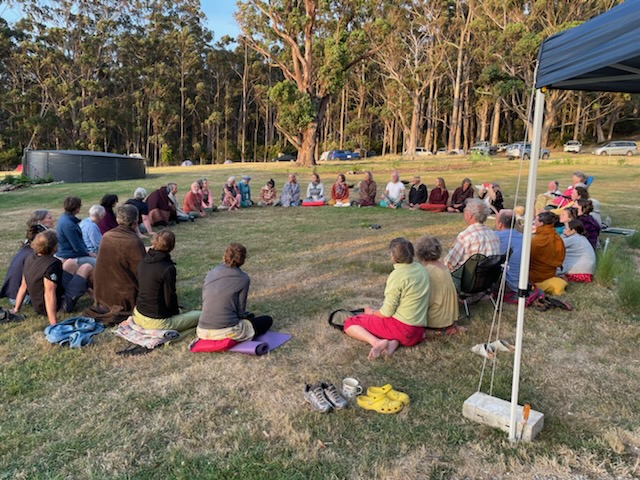
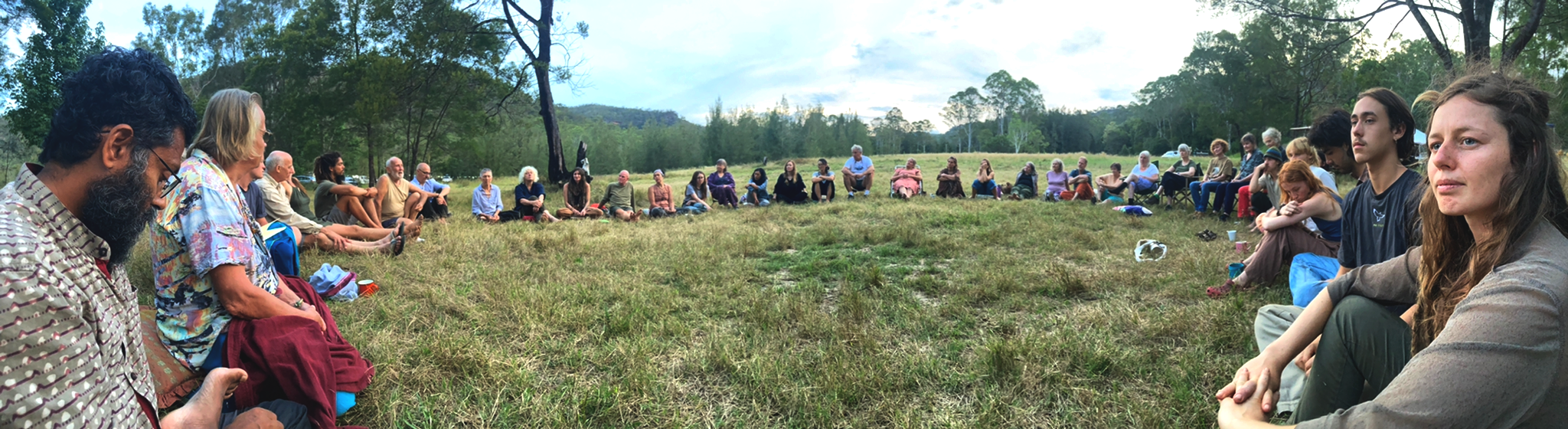
In response to such things, Joanna Macy and I developed a workshop of experiential deep ecology rituals called the Council of All Beings and, with Arne Naess, wrote a book in 1986 called Thinking Like A Mountain – Towards a Council of All Beings (which has been translated into 12 languages). Some of us will be gathering to-morrow at Society of Wilderness to experience a Council of All Beings workshop together.
In this workshop we REMEMBER our rootedness in nature, recapitulate our entire evolutionary journey and release the memories locked in our DNA. We experience the fact that every cell in our body is descended in an unbroken chain 4 billion years old, through fish that learned to walk the land, reptiles who’s scales turned to fur and became mammals, evolving through to the present.
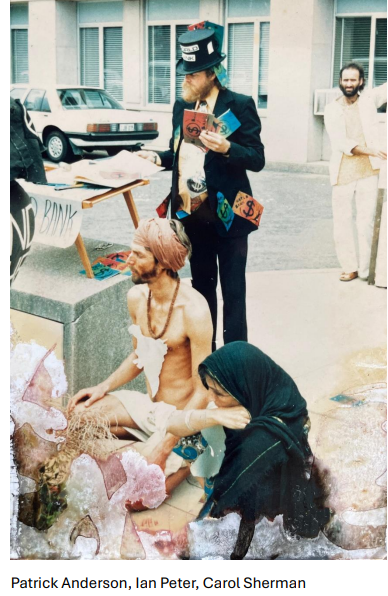
We further extend our sense of identity in the Council of All Beings itself where we find an ally in the natural world, make a mask to represent that ally, and allow the animals and plants and landscapes to speak through us. We are shocked at the very different view of the world that emerges from their dialogue. Creative suggestions for human actions emerge and we invoke the powers and knowledge of these other life-forms to empower us in our lives.
We remember that, until quite recently, humans have been doing ceremonies like this for a long time, hundreds of thousands of years perhaps, and to our surprise, it comes very easily and naturally to us. Invariably we are shocked to hear voices that we have never heard before, profound truths revealed.
One of the rituals at the Council of All Beings is a mourning: we grieve for all that is being lost from the world, the species lost, the landscapes destroyed. Only if we will allow ourselves to feel the pain of the Earth, can we be effective in Her healing. This is why the Vietnamese Buddhist monk, Thich Naht Hanh, said that in order to heal the Earth, “the most important thing that we can do is to hear, inside ourselves, the sounds of the Earth crying”.
We have a deep longing for reconnection with the Earth. With this longing repressed , a host of displacement activities arise. We feel a pervasive anguish and emptiness and spend our lives trying to fill the gaping wound with all manner of “stuff”. We have to dig up and chop down the Earth to make and power all the hair-driers and microwave ovens and electric toothbrushes with which we try, unsuccessfully, to fill the hole.
It’s not really all these material “goods” that we want however, but a certain psychological state that we imagine will follow. It never does follow of course, and no amount of material “stuff” brings us peace.
In response to the question “how is this expansion of identification to be developed?”, Arne Naess responded that what are needed are “community therapies” to develop ecological self.
At first I was very excited by this as it gave me a new perspective on the Council of All Beings. Although I had facilitated many such workshops, I’d never seen them in this light.
After some time however, I came to see certain shortcomings in the “therapy” metaphor. While on Third Mesa in New Mexico, I was privileged to witness an ancient indigenous Hopi ritual. It took place in the town square of the oldest continuously inhabited community in the Western Hemisphere. Although the masks were more splendid and the drumbeat more confident, in many ways it was identical to the Council of All Beings and these people had been doing this regularly for thousands and thousands of years.
But therapies aren’t supposed to last for thousands of years. These ceremonies and rituals have no end. Perhaps the tendency to lose our connection with the living Earth is very ancient. Perhaps it began as soon as we began to think? What else could explain the fact that every intact indigenous culture that we look at has, at it’s root, a series of such ceremonies and rituals whereby the human community can acknowledge and renew and nourish our interconectedness with the land and the rest of the Earth community?
So, although the Council of All Beings is undeniably experienced as being therapeutic by participants, it reveals I think, a deeper significance; One remembers Joseph Campbell’s warning that the chief sources of anxiety in our age are the loss of myth and ritual. We must heal our culture so that it once more provides us with authentic connection between our soul and the Earth. For me, the real work must include reclaiming these rituals and the empowerment that they offer, and to take that empowerment and spread it through our lives, finding ways to serve the Earth.
As I wrote in “Thinking Like a Mountain”, for myself this transformation of perspective from anthropocentrism to deep ecology resulted from my actions on behalf of Mother Earth.
In struggling to protect the rainforests near my home, I found that the sense of
“I am protecting the rainforest”
Changed into
“I am part of the rainforest protecting myself. I am that part of the rainforest recently emerged into thinking.”
What a relief then! The thousands of years of imagined separation are over and we begin to recall our true nature.
Furthermore the spiritual awakening that took place while participating in the defence of the rainforests has obviated the need for any other form through which to experience the divine – the Earth itself has become my sacred text.
However, it is clear that many people’s love of Earth is mediated thru one of the great faith traditions and that each of those traditions has within its texts and liturgies, many expressions of ecological sensibility and love of Earth.
These days, the Earth suffers under the thrall of the religion of the market place which is the dominant spiritual mode of these dark times.
Both nature and the faith traditions falter under the onslaught of the religion of economics, which is, I believe, the most pious religion the world has ever known, worshipping Mammon in skyscraping temples and shopping malls not just one day a week but seven; with worshippers all the more fervent by virtue of being completely unconsciousness that their supposed secularism is, in fact, a profound spiritual faith. I have written about this at some length last year for the University of Western Sydney’s “Handbook of Social Ecology”
I believe that we need to nourish both the growing shoots of ecological concern within the great faith traditions and also nourish spiritual understanding and respect within the conservation movement.
Part of my work has been exploring the overlap of ecology with Christianity, Judaism, Islam, Buddhism and Hinduism.
Earth is where all these mighty faiths meet, each has grown from the soil of this planet and it is in the Earth that they are reconciled. I spoke of this yesterday in the Deep Ecology, Ecopsychology and Eco-spirituality forum.
I have devoted my life to the protection and conservation of nature for over 30 years. During that time I have seen many of my colleagues fall by the wayside, burnt out by the pain of watching the wild nature that they love retreating under the onslaught of “development”. It seems to me that if we want to be able to sustain our gaze decade after decade on such a bleak vision as what is happening to our world, we require constant empowerment and renewal, and these deep ecology practices have served that purpose for me and many of my friends.
Fueled by the empowerment we receive from the deep ecology experiential practices, my colleagues and I have worked on many practical projects for the conservation of nature. I will briefly mention a few of these to end this talk, and if you are interested you can learn more by following the hyperlinks in the online version of this talk.
In Papua New Guinea we provided tribal landowners with small portable sawmills and training in ecological forest management so that they could sustainably utilize their own forests and expel the multinational logging companies.
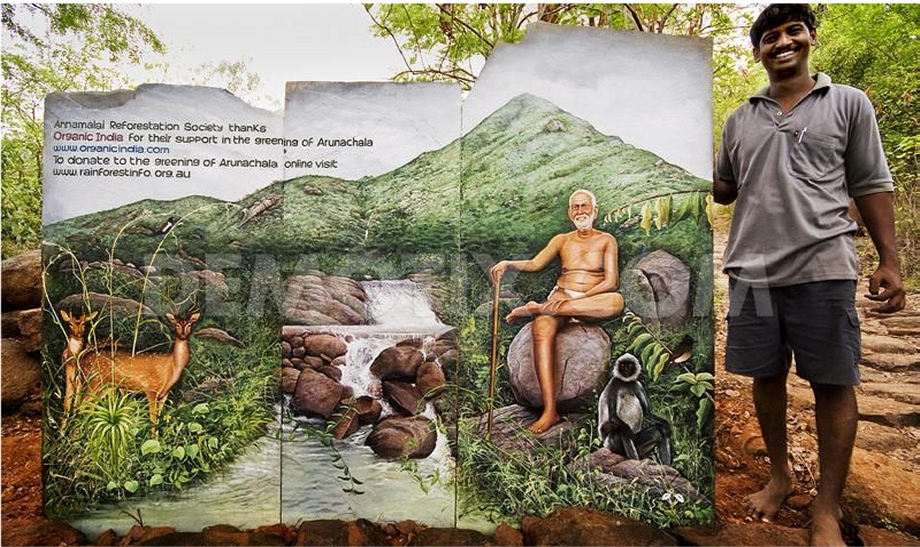
In India in 2009 we worked to stop developments threatening the largest remaining wild population of elephants in Asia and last year worked alongside indigenous people to prevent the mining for bauxite of the sacred mountain which is their god.
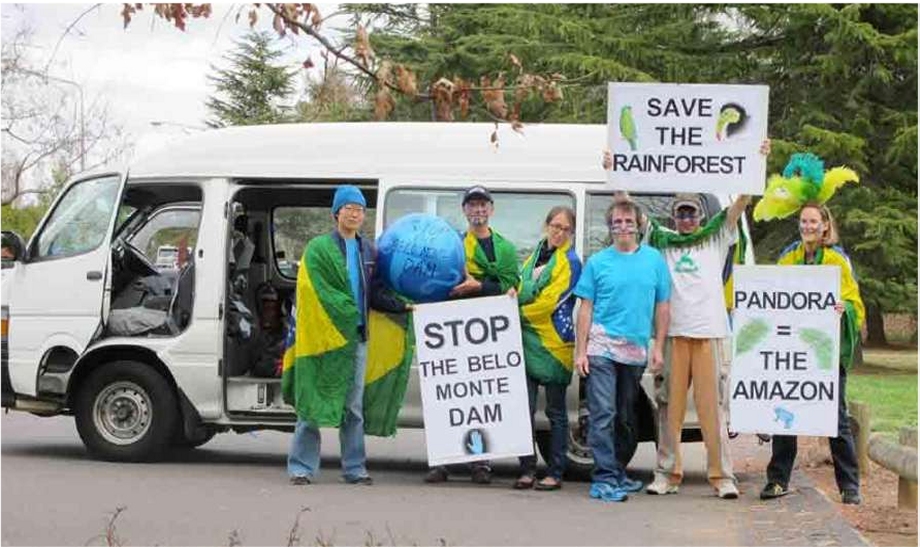
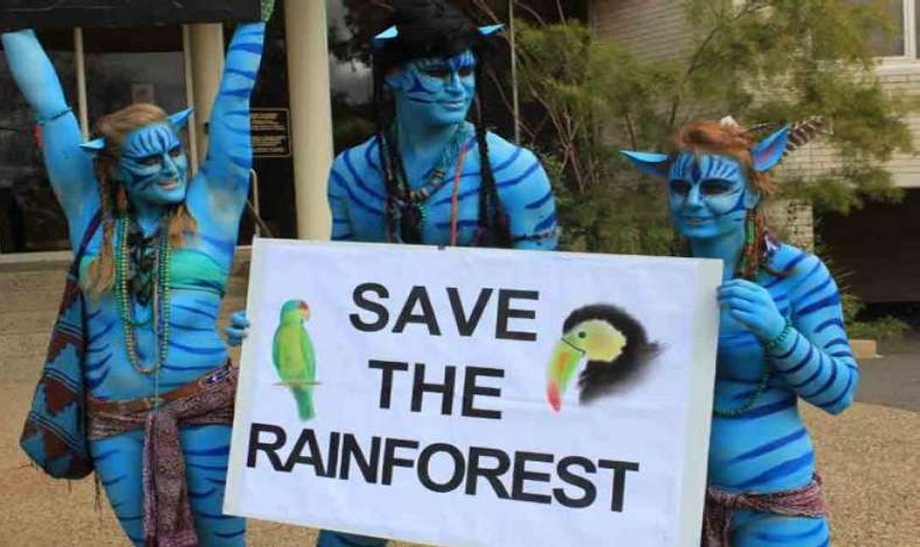
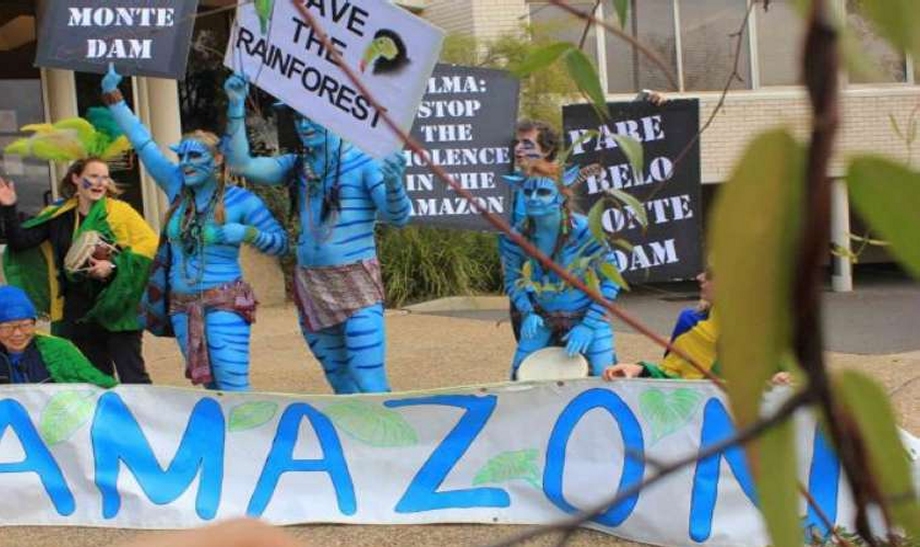
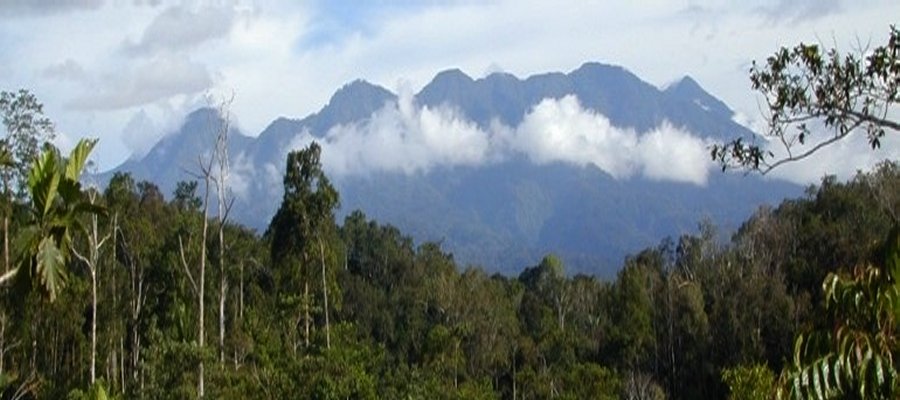
This year we have been working once again on protecting the Tasmanian forests and in March this year we joined the international actions for the forests of Borneo . In April I traveled to different aboriginal communities in Taiwan showing films and telling stories about our successful actions to stop dams destroying wild nature in Australia.In August we had actions at the Brasil Embassy and outside Parliament House in Canberra as part of worldwide actions to stop dams being built in the Amazon basin .
Throughout the 2nd half of 2010 I have been conducting Climate Change, Despair and Empowerment workshops around Australia to encourage environmentalists to honour the anguish that we all feel in the light of what is happening to our world. In particular, I have been doing these workshops for the Australian Youth Climate Coalition, the fastest growing youth organization in Australia which has grown to 65,000 members in just 3 years.
I’d like to conclude by expressing my admiration for the Society of Wilderness who organized this conference and whose tireless volunteers and staff make it such a success. As I have said, I believe that it will be impossible to address the environmental crises that torment us without also addressing the psychological crises that create the mess we’re in. In this, the Society of Wilderness clearly agrees: their Deputy Chairman Chun-lin Chen is a practicing psychiatrist, they have translated and published the most important volume on eco-psychology into Chinese and a number of their volunteers are now facilitating experiential deep ecology processes such as The Council of All Beings.
As I mentioned earlier, I will be conducting a Council of All Beings to-morrow at the Society of Wilderness Taipei office. Please see any of the SOW staff if you would like to participate. If you can’t make it to-morrow, nonetheless register your interest with SOW as they will be conducting more such workshops in the months to come which will be even better than mine as they will be in the Chinese language. Or else invite SOW to provide a facilitator to offer such a workshop for your NGO. This will certainly help to empower your NGO and create an opportunity for new vision, excitement and enthusiasm to emerge.