Ecopsychology and Eco-Spirituality

Presentation to the “Deep Ecology, Ecopsychology and Eco-Spirituality” panel of” APNEC 2011
Eco-Spirituality – some reflections from the perspective of Buddhism, Hinduism and Christianity – John Seed
ABSTRACT: Many people throughout the ages have reported spiritual experiences directly from the natural world, unmediated by a human teacher or religious belief. I myself experience nature as sacred following a religious conversion that I experienced in the Australian rainforest more than 30 years ago. However, most people are embedded in a particular spiritual tradition and in order to understand and experience nature as sacred, such an experience must make sense within the framework of their religious belief system. I will explore some of the growing shoots of ecological concern within three of the world’s dominant faith systems and discuss the importance for nature conservation of nourishing such shoots wherever we can. I will contrast these with the Earth-destroying religion of economics.

As I wrote in “Thinking Like a Mountain”, for myself the transformation of perspective from anthropocentrism to deep ecology resulted from my actions on behalf of Mother Earth.

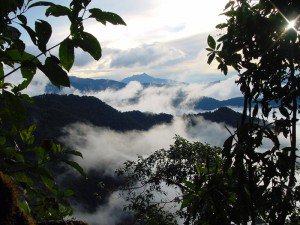
In struggling to protect the rainforests near my home, I found that the sense of

“I am protecting the rainforest”

changed into

“I am part of the rainforest protecting myself. I am that part of the rainforest recently emerged into thinking.”

What a relief then! The thousands of years of imagined separation are over and we begin to recall our true nature.

Furthermore the spiritual awakening that took place while participating in the defence of the rainforests has obviated the need for any other form through which to experience the divine – the Earth itself has become my sacred text.

However, it is clear that many people’s love of Earth is mediated thru one of the great faith traditions and that each of those traditions has within its texts and liturgies, many expressions of ecological sensibility and love of Earth.

These days, the Earth suffers under the thrall of the religion of the market place which is the dominant spiritual mode of these dark times.

Both nature and the faith traditions falter under the onslaught of the religion of economics, which is, I believe, the most pious religion the world has ever known, worshipping Mammon in skyscraping temples and shopping malls not just one day a week but seven; with worshippers all the more fervent by virtue of being completely unconsciousness that their supposed secularism is, in fact, a profound spiritual faith. See my chapter “The Religion of Economics” in the University of Western Sydney’s “Handbook of Social Ecology”

I believe that we need to nourish both the growing shoots of ecological concern within the great faith traditions and also nourish spiritual understanding and respect within the conservation movement.

I have long been interested in exploring the relationship of ecology with Hinduism , Buddhism and Christianity.

Earth is where all these mighty faiths meet, each has grown from the soil of this planet and it is in the Earth that they are reconciled.

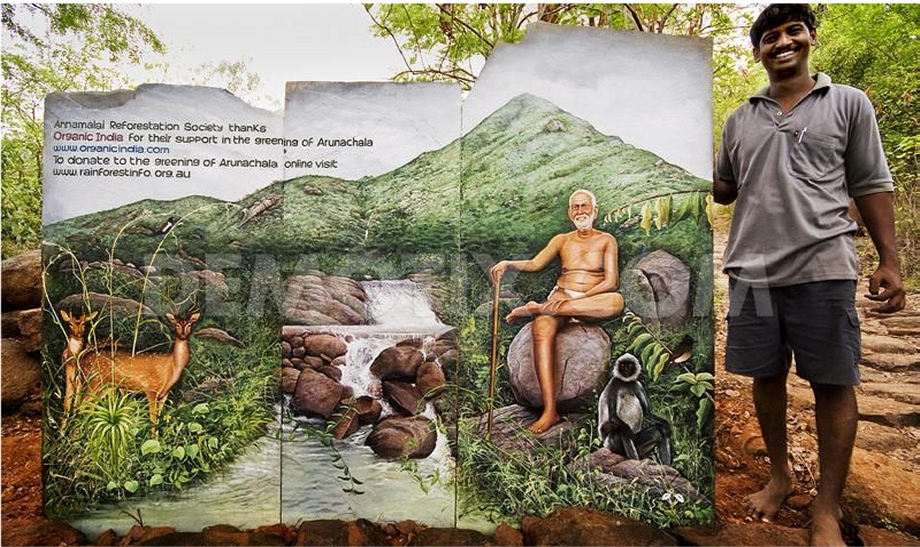
Arunachala, a mountain in the State of Tamil Nadu, is one of the most sacred sites in India. In the Hindu tradition, the story is told that their supreme deity, Shiva, manifested as a column of light stretching from infinity to infinity. He was so bright that the others gods complained that they were being dazzled beyond endurance.

In his compassion, Shiva took on a new form as this mountain, Arunachala, and more than 1000 years ago a vast temple was built at its base. Many believe that walking the 11 km around Arunachala is the fastest way to enlightenment and pilgrims by the millions have thronged there since time immemorial.

In the long line of illustrious sages who have taken up abode in caves on Arunachala was Ramana Maharshi, one of the most celebrated Hindu mystics of the 20th century who died in 1950.

In 1987, the Rainforest Information Centre received a letter from one of the nuns in Ramana’s ashram telling us that when Ramana had arrived at the mountain as a young man, it had been clothed in a mighty jungle and even tigers could be met walking along its flanks. But now, nothing remained but thorns and goats, couldn’t we please do something to help restore the mountain?

We helped her set up an NGO “The Annamalai Reforestation Society” and raised funding for this work including two substantial grants from the Australian Government Aid agency. Two volunteers from Australia spent more than seven years helping to reclothe the sacred mountain.

After some years, the authorities from the main temple invited us to move our tree nursery inside the temple walls and allowed us the use of their precious waters. Consequently, we initiated the regeneration of the temple gardens, growing flowers for their ceremonies as well as hundreds of thousands of native tree seedlings each year. Local authorities liked the beauty of the Temple Gardens and when requested, we gave them thousands of seedlings from our nursery for the regeneration of the gardens of other South Indian temples.

When I returned to Arunachala in 2009, I was heartened to find that more than 10 new NGO’s had sprung up around the base of the mountain. These inspired groups have constructed native tree nurseries and are engaged in tree planting, environmental education, fire prevention and fire fighting. Not only was I able to walk in the cool shade of the trees our project had planted for over 20 years , but I was able to witness also that our idea had taken root, the idea that Shiva could be worshipped by reweaving his ecological robes. A short film about this project, “Reweaving Shiva’s Robes” may be viewed here.
In the ‘90’s some Buddhist friends and I created the Dharma Gaia Trust whose mission was to nurture awareness of the complementarity of Buddhism and ecology. After all, the Buddha was born under a tree, became enlightened under a tree and died under a tree.

Famous saying attributed to the Buddha include: “The forest is a peculiar organism of unlimited kindness and benevolence that makes no demand for its sustenance and extends generously the products of its life activity; it affords protection to all beings, offering shade even to the axeman who would destroy it”
and
” Those who plant trees in temple gardens monasteries and forests will gather merit both day and night”
The “earth witness” Buddha is one of the most common iconic images of Buddhism. It depicts the Buddha sitting in meditation with his left hand, palm upright, in his lap, and his right hand touching the earth. This represents the moment of the Buddha’s enlightenment.

Just before the historical Buddha, Siddhartha Gautama, realized enlightenment, it is said the demon Mara attacked him with armies of monsters to frighten Siddhartha from his seat under the bodhi tree. But the about-to-be Buddha did not move. Then Mara claimed the seat of enlightenment for himself, saying his spiritual accomplishments were greater than Siddhartha’s. Mara’s monstrous soldiers cried out together, “I am his witness!” Mara challenged Siddhartha–who will speak for you?

Then Siddhartha reached out his right hand to touch the earth, and the earth itself roared, “I bear you witness!” Mara disappeared. And as the morning star rose in the sky, Siddhartha Gautama realized enlightenment and became a Buddha.

One of the aims of the DGT was to raise funds for Buddhist-inspired projects in Asia, in particular, projects where monks and nuns are involved in ecological preservation. For example, in Thailand there is an area where forest monks had protected important areas of old growth forests by ordaining the trees, wrapping orange cloth around them and performing the ceremony that turned these trees into Buddhist monks. The wood cutters left alone trees treated in this way. When we learned of this, the Dharma Gaia Trust made gifts of bolts of orange cloth to these monks.

The king of Thailand was impressed by the efforts of these monks that in 2006, to celebrate the 60th anniversary of his coronation, he requested people all around his country to ask their local monks to ordain old trees in his honour and in this way millions of trees received protection.
In 1998 I was able to visit Thailand, meet Phra Khrumanus Nateephitux, the monk responsible for originating the practice of tree-ordination and participate in a number of tree ordination ceremonies (photos)
DGT also raised funds for the temple forest project in Sri Lanka, which joined together corridors of the original vegetation of that country. So much of the biodiversity of Sri Lanka has been destroyed, that the sacred groves adjacent to many old temples now harbor a surprising proportion of the remaining plant and animal species. In many places all of the original forest has been cut, with the exception of these ancient groves that date back a thousand years or more. By connecting these groves and purchasing strategically placed land around them, many species of plant and animal life that they harbor were protected.
For example the Watarakkgoda Raja Maha Viharaya Temple dates back to the 9th century and the current abbot of this temple, Rev. Dodankumbure Deerananda is deeply committed to protecting his temple forests and sacred groves extending both their biodiversity and cultural influence. He is interested in the conservation of nature in general and has developed a bikkhu training center in environmental issues at his temple for the hundreds of young priests who come to him each year for their religious training. Dharma Gaia Trust was able to raise funding for his work.

Finally, DGT has worked with the Tibetan Government in exile to teach organic agriculture to Tibetan refugee communities in India and helped establish Tesi Environmental Awareness Movement, the first Tibetan environmental NGO and fund some of their education programmes.

Modern Christianity is largely anti-ecological, especially among the evangelicals who make up about 30% of the population of the US and who teach their children to disdain protecting the earth for future generations because it has all been put there for man to use and soon the Rapture will end the earth, Christians will go to heaven and everyone else to hell.

A leading exemplar of this position was James Watt, US Secretary of the Interior under Ronald Reagan. In 1981 he said that “My responsibility is to follow the Scriptures which call upon us to occupy the land until Jesus returns.” (The Washington Post, May 24, 1981) and “We will mine more, drill more, cut more timber.” In his testimony before the House Interior Committee, February 1981 he said: “That is the delicate balance the Secretary of the Interior must have: to be steward for the natural resources for this generation as well as future generations. I do not know how many future generations we can count on before the Lord returns”

This attitude stems from the mainstream interpretation of the Old Testament which says that only man was created in God’s image, the rest of nature not, that only humans have a soul, that man is to have dominion over nature and that the other creatures are to be “in fear and trembling” of us.

It is of the utmost importance then, to support and nourish those counter movements within Christianity which venerate the Earth and have a more ecological attitude. Modern exemplars include Thomas Berry and Matthew Fox and this thread in Christianity goes back via Teilhard de Chardin ( “Our faith imposes on us a right and duty to throw ourselves into the things of the earth”) and Meister Eckhart (“Every human person is an aristocrat. Every human person is noble and of royal blood, born from the intimate depths of the divine nature and the divine wilderness”) all the way back to the 12th century and St Francis of Assisi as Yih-ren describes in his paper to this panel. I will just add one quote from St Francis:” All praise be yours my Lord, through Sister Earth, our mother, Who feeds us in her sovereignty and produces various fruits and coloured flowers and herbs.

Unfortunately Christianity has recently been eclipsed by one of its children, classical economics. If we dig at the foundations of classical economics we discover its Judeo-Christian roots: nothing has any value till humans add their labour and intelligence to it. The Earth itself is just dirt till we dig it up and turn it into our toys. Only then, when the miracle that is man transforms lowly Earth into trinkets, does it acquire any value.

Just as Christianity usurped the sacred sites and holy days of the pagan religions they overthrew, now Christianity has been overthrown by its own offspring. A case –in point is the transformation of Saint Nicholas, a fourth-century Christian saint, into Santa Claus, a modern and postmodern god of consumerism. This also explains the success of best-selling books like “God Wants You to be Rich” and “Jesus, CEO”. What used to be the solstice was subsumed by Christmas and this in turn has been swallowed by shopping.

So, I end this presentation where I began, with the religion of economics: if we want the Earth to survive the modern era, we must not only nourish the ecological growing shoots in the major world religions, but we must also expose the supposedly scientific “discipline” of economics for the rabid, Earth-destroying religion that it is beneath its secular disguise.

No comments yet.
No trackbacks yet.